Heimlich Maneuver in Cats: How to Perform Heimlich Maneuver If a Cat Is Choking



Adobe Stock/kou234122
As a pet parent, one of the most frightening things is to see your cat or dog in distress.
If your cat is showing signs of choking on a foreign object, here are things you need to know and how to perform the Heimlich Maneuver.
It is important to stay calm, so you can best help your pet when precious seconds count.
Key Takeaways
- Choking in cats can be life-threatening. Signs of a cat choking include gagging, coughing, blue gums, and/or a cat collapsing.
- The Heimlich maneuver can be performed on cats using careful abdominal thrusts and back pats to dislodge the object.
- After a choking incident, it's crucial to have your cat examined by a veterinarian to check for internal injuries or complications.
Signs That Your Cat Is Choking
If your cat is choking, they will show the following symptoms:
-
Gagging, retching, and heaving (open mouth, no noise)
-
Coughing (especially as they exhale)
-
Raspy sounds as they inhale
-
Frantic or in distress
-
May paw at their face, rub their face on the ground, and seem panicked
-
-
Stretching the neck outward
-
Staggering
-
Blue gums
-
Collapse
What to Do if Your Cat Is Choking
First, confirm your cat is choking by taking a moment to gather your composure while staying calm.
Next, safely restrain your pet so you can evaluate and assist them. Remember, your pet is very scared and may react differently than usual, so approach with caution.
If you can safely do so, open their mouth to see if there is anything is stuck or causing an obstruction.
You may try to pull the tongue forward to get a better view of the back of the throat. If you can visualize the object that is causing them to choke and can safely do so, sweep your index finger through the mouth to attempt to dislodge anything that may be stuck.
Do not poke your finger down or attempt to push anything down their throat, as this could cause injury.
If you are unable to visualize anything in the mouth or cannot safely sweep the mouth with your index finger, move on to the Heimlich maneuver.
How to Perform the Heimlich Maneuver In Cats
If your cat is choking:
-
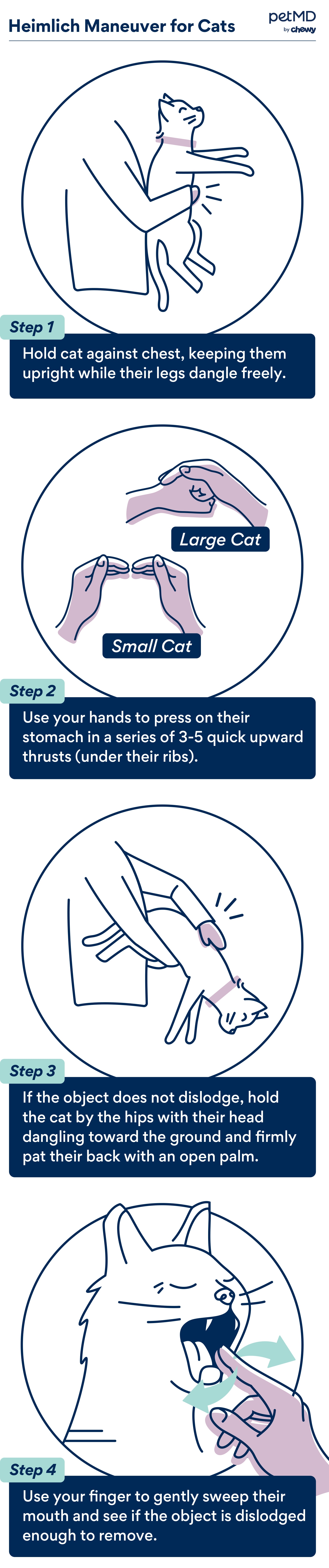
Start by holding your cat against your chest so their back is touching your chest (keeping them upright, with their head up and legs dangling freely).
-
Use your hands to press on their stomach in a series of three to five, quick, upward thrusts
-
You should feel a soft hollow under the ribs where your fist fits
-
Depending on the size of your cat, you will use your fist (large cat) or fingertips (small cat) to move in quick “up” and “in” motions toward their head
-
Use your finger to gently sweep the mouth again (if able to do so safely)
-
If the object in their mouth did not come out, hold your cat by their hips with their head dangling toward the ground, and firmly pat them on their back with an open palm
-
Check the mouth again by performing a sweep with your finger
-
Once the object is dislodged, your cat should start to breathe more normally than before, and their gums should return to a “pinkish” color
If the above steps are not working, immediately go to your nearest veterinarian or emergency veterinary hospital.
If your cat becomes unconscious, immediately check for a heartbeat and breathing. You’ll need to transport them to an emergency veterinarian for treatment. The chest will rise and fall with each breath and a pulse can be felt on the inner thigh.
Until these are restored, CPR should be performed if breath and pulse are not detected, and only when another person is providing transportation.
What To Do After You Stopped Cat From Choking
Once your cat has stopped choking and seems to be back to their “normal self”, it is important to have them evaluated by a veterinarian right away.
They need to make sure there are no injuries from the object that caused them to choke, or from the pressure of the Heimlich maneuver.
How To Prevent Choking in Cats
Make sure to cat-proof your home and try to prevent access to items that your cat may view as fun to chew or play with.
Common things that cats may choke on include:
-
Arts and crafts supplies (pipe cleaners, pom poms, googly eyes, cotton balls, yarn, buttons)
-
Office supplies (paper clips, staples, rubber bands, thumb tacks)
-
Kitchen supplies (straws, foil, plastic bags, cellophane, bottle caps, wine corks)
-
Toys (with strings, feathers, bells, or other small pieces that may detach)
-
Coins
If cat-proofing your entire home isn't possible, consider keeping your cat out of high-risk areas using a tall cat gate.
If you have a cat that eats quickly and doesn’t chew their food before swallowing, it may be helpful to feed smaller, more frequent meals or use a slow feeder to help minimize the possibility of choking.
A cat choking can be a traumatic experience for any pet parent. Knowing how to perform the Heimlich maneuver on your cat will help you prepare should the emergency happen.